
All Articles
-
 It Passed the Test. That Doesn't Mean It Works.
Every testing, monitoring, and reliability practice you own rests on one assumption: same input, same output. An LLM in the call path removes it. What replaces it is evaluation, thresholds, and verification as an explicit architectural layer with a cost and an owner.
Read more → -
 When Everything Is Critical, Nothing Is
Reliability isn't only a technical property, it's an ownership property. Two decisions sit underneath every reliable system, what actually matters and who is accountable for keeping it up, and most organizations have made neither.
Read more → -
 What the EU AI Act Actually Requires (And What It Doesn't)
The EU AI Act's reach extends to any company whose AI system's output is used by people in the EU, no European office required. A plain-language breakdown of the four risk tiers, what high-risk systems (hiring, credit, biometrics) must actually do, and what the Act does not require.
Read more → -
 Scalability Thinking Has a New Dimension
AI coding assistants let teams move faster, but velocity changes the risk profile of an existing system. Boundary clarity, narrow contracts, and continuous architectural validation are what make a system evolvable at AI speed, not just human speed.
Read more → -
 The Difference Between AI Safety, AI Ethics, and AI Governance
"AI safety concerns" means something different to engineering, legal, and the ethics lead — and that confusion wastes meetings. Safety asks what could go catastrophically wrong, ethics asks what we should do, and governance asks how we prove we did it. Three distinct disciplines, often mistaken for one.
Read more → -
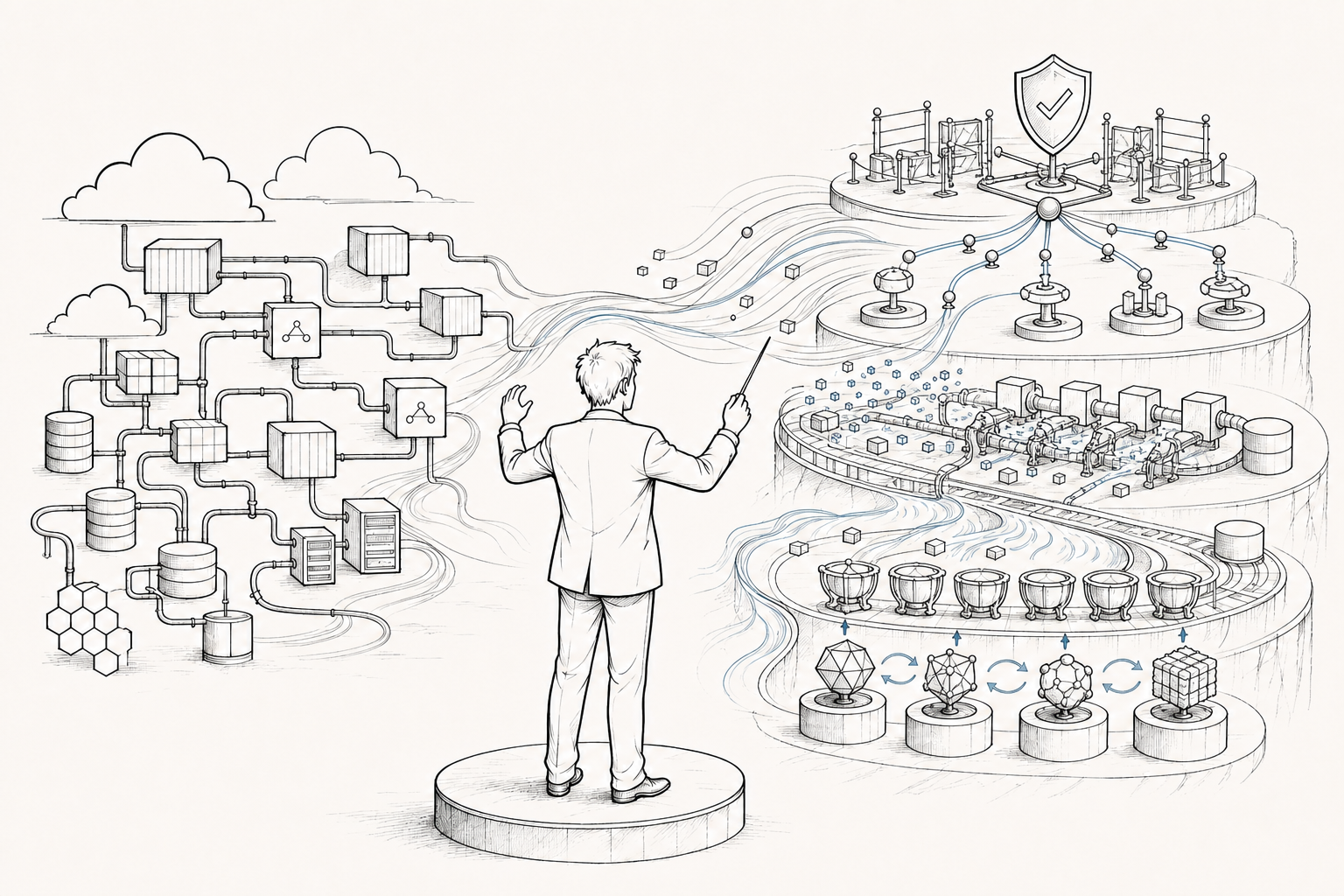 From Cloud-Native to AI-Native: The Next Evolution of Enterprise Architecture
Every enterprise says it's adopting AI, the same way every enterprise once said it was in the cloud. Bolting AI features onto an existing system is the new lift-and-shift — the four-properties test for what genuinely AI-native architecture requires instead.
Read more → -
 Fairness in AI: Is Fairness Even Possible?
There are at least six distinct, defensible definitions of AI fairness — demographic parity, equal opportunity, equalized odds, predictive parity, individual fairness, counterfactual fairness — and a proven mathematical result shows several are incompatible with each other. Every consequential AI system has already chosen one, whether the team meant to or not.
Read more → -
 Why "The Algorithm Decided" Is Never an Acceptable Answer
"The algorithm decided" isn't an explanation — it's a way organizations dodge accountability for the human choices baked into a system. What accountability actually requires as an architecture: explainable decisions, genuine human authority, auditable logs, and a real escalation path.
Read more → -
 The Single-Architect Availability Problem
Reliability engineering asks what happens when a component becomes unavailable. Most organizations never ask that about the person who holds all the architectural context — and the six-week test to find out if you have that single point of failure.
Read more → -
 The Five Ethical Risks Every AI System Carries
Even a plain product recommendation engine carries all five structural ethical risks of AI: bias, opacity, accountability gaps, privacy exposure, and harm potential. They aren't specific to controversial applications — they come with the technology itself, and the only variable is how well a team manages them.
Read more → -
 The Lesson at the Heart of The Software Conductor
A conductor who steps off the podium to play an instrument makes the ensemble worse, not better. The Hero Trap — architects jumping in to solve problems themselves instead of building their team's judgment — is the idea at the center of The Software Conductor, and the one that took longest to really land.
Read more → -
 What AI Ethics Actually Means for Engineers
AI ethics gets used to mean three different things at once: philosophical principles, technical system properties, and governance. For engineers, the leverage is in the middle layer — the three zones (building, deploying, consuming AI) where fairness, accountability, and transparency are architectural properties you either build in or leave out.
Read more →