
The Line AI Is Drawing in Your Architecture Team
You’ve probably read a dozen articles about how AI tools are changing software development. Code generation. Developer productivity. Faster PRs, smaller backlogs, fewer boilerplate hours. Most of this coverage focuses on what developers do with their time, which is genuinely interesting. But there’s a different question that matters more for your architecture practice.
What happens to the architecture team when AI absorbs the execution layer of software work?
That question has a different answer than you might expect. And the implications go well beyond any individual architect’s career.
The Execution/Origination Divide
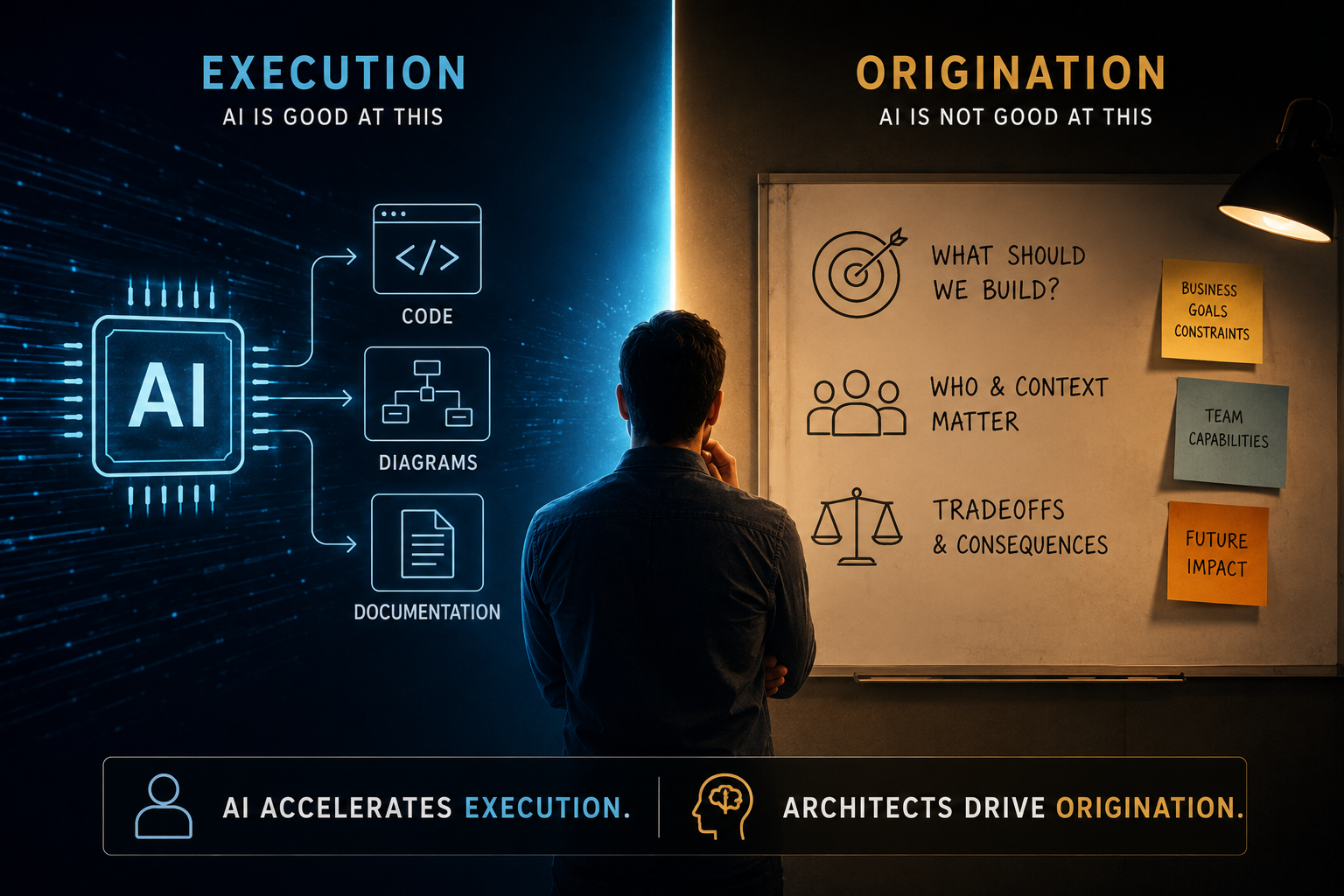
Most work in software development sits on a spectrum between execution and origination.
Execution is work that implements a decision that’s already been made. Writing the service that was spec’d out last sprint. Generating the API boilerplate. Drafting the architecture diagram that documents the design the team already agreed on. This work requires skill and care, but it doesn’t require judgment about what should be built or why the system should be structured the way it is.
Origination is the work that creates those decisions in the first place. Determining the right decomposition for this team, given their size and their capabilities and the business constraints they’re operating under. Understanding which architectural tradeoffs matter for this particular system’s growth trajectory. Recognizing that the way three teams are structured will produce a very specific kind of coupling problem in six months, even if the code looks clean today.
AI is very good at execution. It is not good at all at origination. And that asymmetry is drawing a line through the middle of software architecture work that most teams haven’t fully reckoned with yet.
What This Means for Architecture Teams
When I say AI is good at execution, I truly mean it. Tools today can generate architectural documentation, produce diagram scaffolding, identify common anti-patterns in code, and suggest refactoring approaches. They can synthesize a set of requirements into a plausible architecture proposal in minutes. This is useful. It’s also exactly the kind of output that a junior architect used to spend most of their time producing.
This raises an interesting organizational question. If AI is handling a significant portion of the execution layer, what does your architecture team actually need to look like?
Most teams haven’t thought this through carefully. They’ve added AI tools to their existing workflows and measured the productivity gain. What they haven’t done is ask whether the composition of the architectural work (the ratio of execution to origination) has shifted enough to require rethinking the structure and expertise in the team itself.
If execution work gets faster, then developers and architects focus more on origination. A team that’s structured to produce lots of architectural artifacts quickly, may find itself under-invested in the judgment that makes those artifacts worth anything.
Where AI Genuinely Helps (and Where It Doesn’t)
AI tools provide real value in architectural work, and that value truly valuable.
They’re particularly useful for accelerating pattern recognition. AI can surface known approaches to known problems faster than any individual architect can recall from memory. They’re useful for drafting initial proposals that a team can critique and improve, which often gets to a better outcome faster than starting from a blank page. They can help with consistency checks across a large codebase, catching places where architectural standards have drifted.
What they don’t do is understand the organizational context that makes an architectural decision right or wrong for this specific team at this specific moment. A decomposition that works beautifully in a microservices context with three self-sufficient teams falls apart when two of those teams have chronic staffing shortages and a shared service that neither fully owns. An AI can generate the architecture. It cannot assess whether that architecture is survivable given the humans who have to operate it.
That judgment, the understanding of how the technical structure interacts with the organizational structure, is exactly what experienced architects bring. It’s also precisely the kind of work AI makes more important, not less. This is because it’s the work that determines whether the AI-generated execution layer is pointed in the right direction.
The Real Organizational Risk
The real risk is organizations that use AI to accelerate architectural execution without investing in architectural origination capability.
I know, it’s seductive. You can produce more documentation, more design proposals, more architecture review throughput. The visible outputs of architectural work increase. The invisible input, the quality of judgment driving those outputs, doesn’t increase.
What you end up with is a lot of well-formatted decisions that aren’t actually good decisions. Systems that look coherent on paper but don’t reflect the real constraints of the teams building them. Architecture that was executed efficiently toward the wrong target.
The line AI is drawing through your architecture team isn’t between the jobs AI will take and the jobs it won’t. It’s between the work that requires human judgment and the work that doesn’t. Organizations that understand that distinction are going to build better systems than the ones that just measure how many more diagrams they’re producing per quarter.
The baton is still in the architect’s hands. The question is whether they’re using it for the right things.
I explore the execution/origination distinction and what it means for the craft of software architecture in my new book, The Software Conductor, available now.